
Content Moderation & Compliance
Pre-upload screening, CSAM detection, and authority reporting.
C2PA verification proves where content came from. It does not prove that the content is safe to publish. A real camera can photograph illegal material. A verified AI tool can generate prohibited imagery. Apertrue screens every upload for prohibited content before it enters the platform — regardless of verification status.
This section describes what Apertrue screens for, where in the pipeline screening occurs, which authorities receive reports, and how UK regulatory requirements shape the system. Implementation details — specific models, thresholds, and scoring logic — are intentionally omitted.
What is screened
Priority illegal content
These categories trigger immediate action. Content is blocked before encryption, evidence is preserved, and relevant authorities are notified:
| Category | Action | Reported to |
|---|---|---|
| Child sexual abuse material (CSAM) | Immediate removal, evidence preserved | NCA, NCMEC, IWF |
| Terrorism content | Removal within 1 hour | CTIRU (Counter Terrorism Internet Referral Unit) |
| Extreme pornography | Immediate removal | NCA if applicable |
| Revenge pornography | Removal within 24 hours | Platform removal (no mandatory authority reporting) |
Sexual synthetic media
Sexual synthetic media of real, identifiable people is a core protection category. Apertrue screens for AI-generated faces placed into sexual content, face swaps, face morphs, facial attribute edits, and expression manipulation. This applies regardless of whether the content carries a C2PA manifest — a "verified AI-generated" label does not exempt content from this screening.
Other prohibited content
| Category | Response time |
|---|---|
| Hate speech and hate crime incitement | Within 48 hours |
| Severe harassment | Within 48 hours |
| Self-harm content and promotion | Within 48 hours |
| Graphic violence | Within 72 hours |
| Content harmful to children | Within 24 hours |
Screening pipeline
Screening runs as a multi-layer pipeline. Every upload passes through all layers — a match at any layer can block the content. The layers run in sequence, with the cheapest checks first:
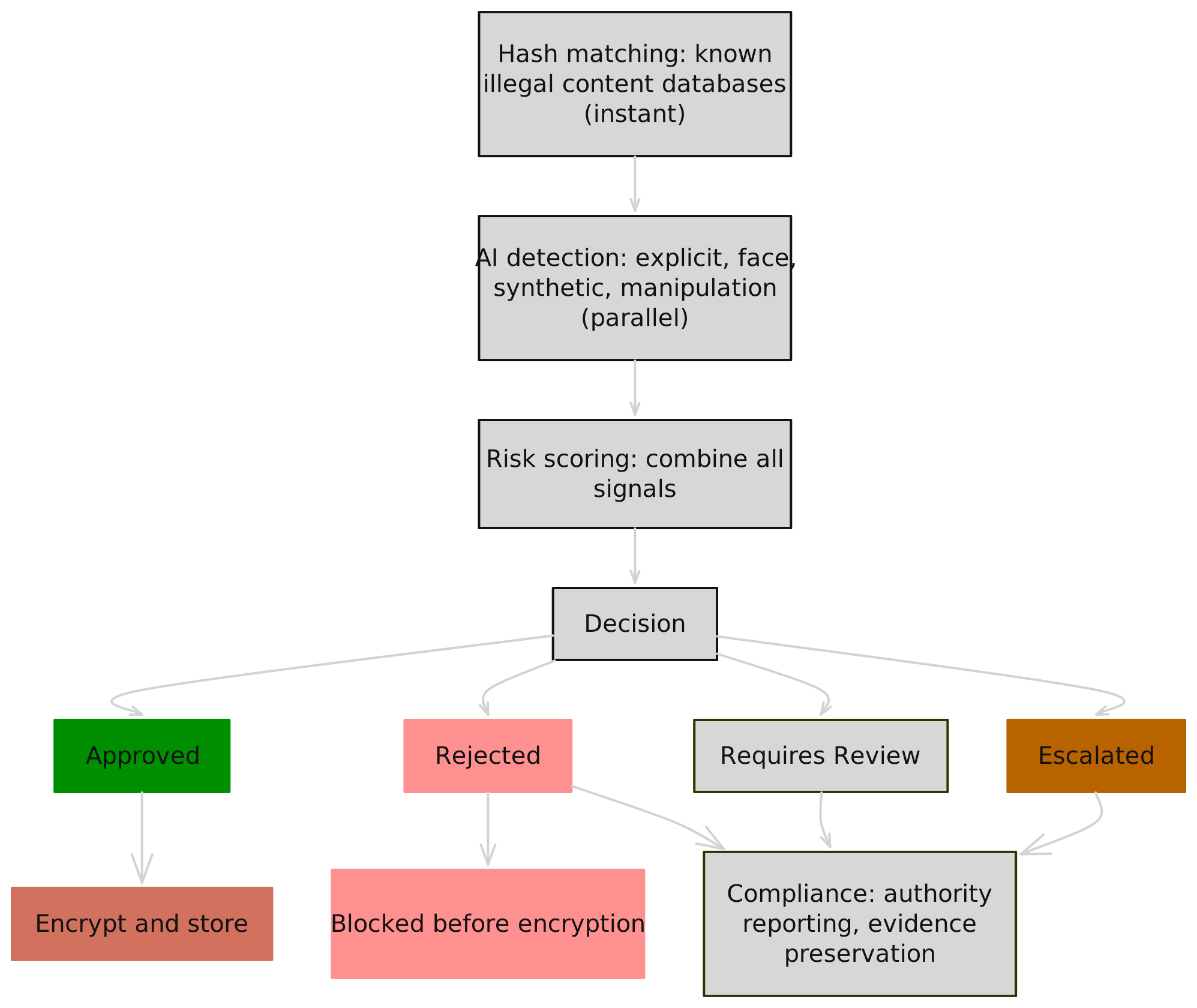
- Hash matching. The image's perceptual hash is checked against databases of known illegal content. This is the fastest check — a hash table lookup that runs before any AI analysis. A match on a CSAM hash triggers immediate escalation with no further processing.
- AI detection. Multiple detection systems run in parallel, each specializing in a different category: explicit content, face presence, synthetic media generation, and face manipulation. Using multiple independent systems provides redundancy — no single system's failure creates a gap.
- Risk scoring. Signals from all detection systems are combined into a risk assessment. The combination logic accounts for the relative severity of each category and the confidence of each detector.
- Decision. The risk assessment produces one of four outcomes: approved (content proceeds to encryption and storage), rejected (content blocked), requires review (queued for human moderator), or escalated (immediate compliance action).
- Compliance. For escalated content, the system generates an evidence package and submits reports to the relevant authorities. Evidence is preserved with a chain of custody for potential legal proceedings.
Screening and privacy
Moderation and privacy are in tension. Apertrue's design resolves this by screening content at a specific point in the pipeline — after the user selects files but before encryption:
- Plaintext window. Content exists in plaintext only during the upload pipeline — between file selection and encryption. Screening happens in this window. After encryption, the backend stores only ciphertext and cannot inspect content.
- Hash-only lookups. Known-content hash matching uses perceptual hashes, not the image itself. The hash is a one-way fingerprint — the image cannot be reconstructed from it.
- No post-hoc decryption. Once content is encrypted, the backend cannot decrypt it for moderation. There is no "backdoor" or key escrow. If content bypasses screening (a bug, a novel attack), the only recourse is to remove the encrypted blob by ID — the backend cannot verify what it contains.
- C2PA is orthogonal. C2PA verification proves provenance. Moderation verifies safety. They run independently. A camera-verified image from a trusted device still undergoes full moderation screening.
The "This Is Me" program
Sexual synthetic media is uniquely harmful because it targets specific, identifiable people. The "This Is Me" program provides a direct path for victims to report content and have it removed:
- Report. The victim submits a report identifying the content and providing their email address.
- Identity verification. The victim provides a selfie. The system checks whether the face in the selfie matches the face in the reported content. The selfie is not stored — only a hash is retained after verification.
- Fast-track removal. If identity is verified, the content is fast-tracked for removal. The victim can optionally be added to a protection database for proactive screening of future uploads.
- Evidence package. An evidence package is generated for the victim's use in legal proceedings, including timestamps, content identifiers, and chain of custody documentation.
UK regulatory compliance
Online Safety Act 2023
Apertrue operates under the UK Online Safety Act 2023 with Ofcom as the regulatory body. The Act requires platforms to:
- Conduct risk assessments for illegal content and content harmful to children
- Implement proportionate systems for identifying and removing illegal content
- Provide clear and accessible reporting mechanisms for users
- Publish transparency reports on content moderation actions
- Implement age verification or age estimation for content harmful to children
- Respond to Ofcom information requests and comply with enforcement notices
Response time commitments
| Content type | Target | Authority |
|---|---|---|
| CSAM | Immediate (0 hours) | NCA, NCMEC, IWF |
| Terrorism | Within 1 hour | CTIRU |
| Sexual synthetic media / revenge porn | Within 24 hours | Platform action |
| Severe harassment / hate speech | Within 48 hours | Platform action |
| Other prohibited content | Within 72 hours | Platform action |
Age verification
Content classified as harmful to children requires age gating. The system supports multiple verification methods — document verification, mobile network verification, digital identity services, and facial age estimation. Only an age bracket is stored (Under 13, Teen 13-15, Teen 16-17, Adult), never the exact date of birth or identity document.
Data residency
All user data and media are stored in UK-approved data centers. Foreign government requests for user data are redirected to the UK legal process (Mutual Legal Assistance Treaty). Apertrue does not comply with foreign government requests directly — all requests must go through UK courts.
Authority reporting
When prohibited content is detected, reports are submitted to the relevant authorities:
| Authority | Abbreviation | Receives reports for |
|---|---|---|
| National Crime Agency | NCA | CSAM, extreme pornography |
| National Center for Missing & Exploited Children | NCMEC | CSAM (CyberTipline) |
| Internet Watch Foundation | IWF | CSAM, child exploitation |
| Counter Terrorism Internet Referral Unit | CTIRU | Terrorism content |
Each report includes a preserved evidence package: the content identifier, detection timestamps, the detection category, account information (where available), and chain of custody metadata. Evidence is preserved in compliance with legal requirements even after the content is removed from the platform.
Transparency reporting
Apertrue publishes quarterly transparency reports covering:
- Content moderation statistics. Total uploads, content removed by category, average review time.
- Synthetic media statistics. Sexual synthetic media blocked, face manipulation detections, total synthetic content actions.
- "This Is Me" program. Claims received, identities verified, content removed from verified claims.
- Legal requests. UK government requests (received, complied, rejected), law enforcement requests, court orders, foreign government requests redirected to UK process.
- Authority reports submitted. CSAM reports to NCA/NCMEC/IWF, terrorism reports to CTIRU, broken down by category.
- Appeals. Appeals received, upheld, rejected, average resolution time.
- Proactive vs reactive. Content detected by automated systems (proactive) vs content reported by users (reactive), with detection rate.
- Verification transparency. Verification volume by content type (camera, AI-generated, mixed), trust list updates, and circuit version changes.
Reports are published in both human-readable and machine-readable formats, accessible to the public without requiring an account.
Human review
Automated screening is the first line, but ambiguous cases are escalated to human moderators:
- Review queue. Content flagged as "requires review" enters a moderation queue with the automated detection signals, the content, and relevant context.
- Moderator actions. Reviewers can dismiss the flag (false positive), take action (remove content, suspend account), or escalate further.
- Moderator notes. Every review decision is logged with the moderator's reasoning, creating an audit trail for accountability and appeals.
The next section covers the backend architecture — the Rust services that power the API, proof verification, media storage, and the moderation pipeline.