
The Trust Problem
Why photo trust is broken and existing solutions fall short.
A photo used to be evidence. If you had a photograph of something, it was reasonable to believe that thing happened. That assumption is now broken, and the tools that broke it are free, fast, and getting better every month.
What changed
Three things happened simultaneously:
AI image generation became indistinguishable
Diffusion models (Stable Diffusion, Midjourney, DALL-E, Flux) produce photorealistic images that fool human observers and most detection algorithms. Deepfakes of real people are generated at scale. The cost is essentially zero and the output is improving faster than detection can keep up.
Metadata is trivially stripped or forged
EXIF data — timestamps, GPS coordinates, camera model — can be removed by taking a screenshot, re-saving the file, or uploading to any social platform. It can also be fabricated. No court or insurance company should rely on EXIF metadata as proof of anything, yet many still do.
Distribution destroys provenance
Every platform that hosts images (Twitter/X, Instagram, WhatsApp, Telegram) strips metadata on upload for privacy reasons. By the time a photo reaches a journalist, insurer, or court, there's no reliable way to trace it back to the device that captured it.
The consequences are already here
- Courts are increasingly skeptical of photo evidence. Lawyers now routinely challenge the authenticity of digital images, and judges are right to be uncertain.
- Insurance companies face a growing volume of fraudulent claims supported by AI-generated or manipulated photos of damage, injuries, and property.
- Newsrooms can no longer verify user-submitted photos with confidence. Reverse image search and metadata checks are insufficient against modern generation tools.
- Individuals have no way to prove their photos are real when accused of fabrication, or to disprove manipulated images of themselves.
C2PA is a partial answer
The Coalition for Content Provenance and Authenticity (C2PA) is an open standard backed by Adobe, Microsoft, Google, Intel, the BBC, and camera manufacturers including Leica, Sony, and Nikon. It embeds a cryptographic signature into images at the point of capture or generation.
A C2PA manifest contains:
- A certificate chain identifying the signing device or software
- A COSE signature proving the image hasn't been modified since signing
- Edit history (actions performed on the image)
- Optionally: GPS coordinates, timestamps, AI generation declarations
This is genuinely useful. If an image has a valid C2PA manifest signed by a Leica camera, you know a Leica camera produced it and nothing has been altered since. The standard is being adopted: Google Pixel phones now sign photos with C2PA, Adobe products embed C2PA manifests, and Content Credentials verification is rolling out across platforms.
But C2PA has a privacy problem
To verify a C2PA manifest, you need access to the full certificate chain. That chain reveals:
- The device manufacturer and model
- The specific signing certificate (potentially traceable to an individual device)
- Any embedded location data
- Exact capture timestamps
- The full edit history and software used
For a journalist in a hostile country, a whistleblower documenting wrongdoing, or an activist recording human rights abuses, this metadata is dangerous. C2PA forces a choice: prove your photo is real and expose your identity, or protect your identity and lose the ability to prove authenticity.
And a reach problem no standard can fix alone
Signing has to be built into the camera at manufacture. The newest flagships ship with it and adoption is growing, but the hundreds of millions of cameras already in use will never gain signing hardware. A standard that starts at the point of capture cannot reach the cameras that predate it, and those are most of the cameras in the world.
Why detection doesn't work
The alternative approach — training AI to detect AI-generated images — is fundamentally flawed as a long-term strategy:
- Arms race. Detectors improve, generators adapt. Each new model generation defeats the previous generation of detectors. There's no theoretical reason to believe detection will ever reliably outpace generation.
- False positives. Detection models regularly flag real photos as AI-generated, especially photos with unusual lighting, heavy processing, or uncommon camera sensors.
- No legal weight. A probabilistic "85% likely AI-generated" result is not evidence. Courts need certainty. Cryptographic proofs provide it.
- Post-hoc only. Detection can only be applied after distribution. By the time a fake is identified (if it is), the damage is done. Provenance verification works at the point of creation.
The right model: prove, don't detect
Instead of trying to detect fakes after the fact, the right model is to prove authenticity at the source:
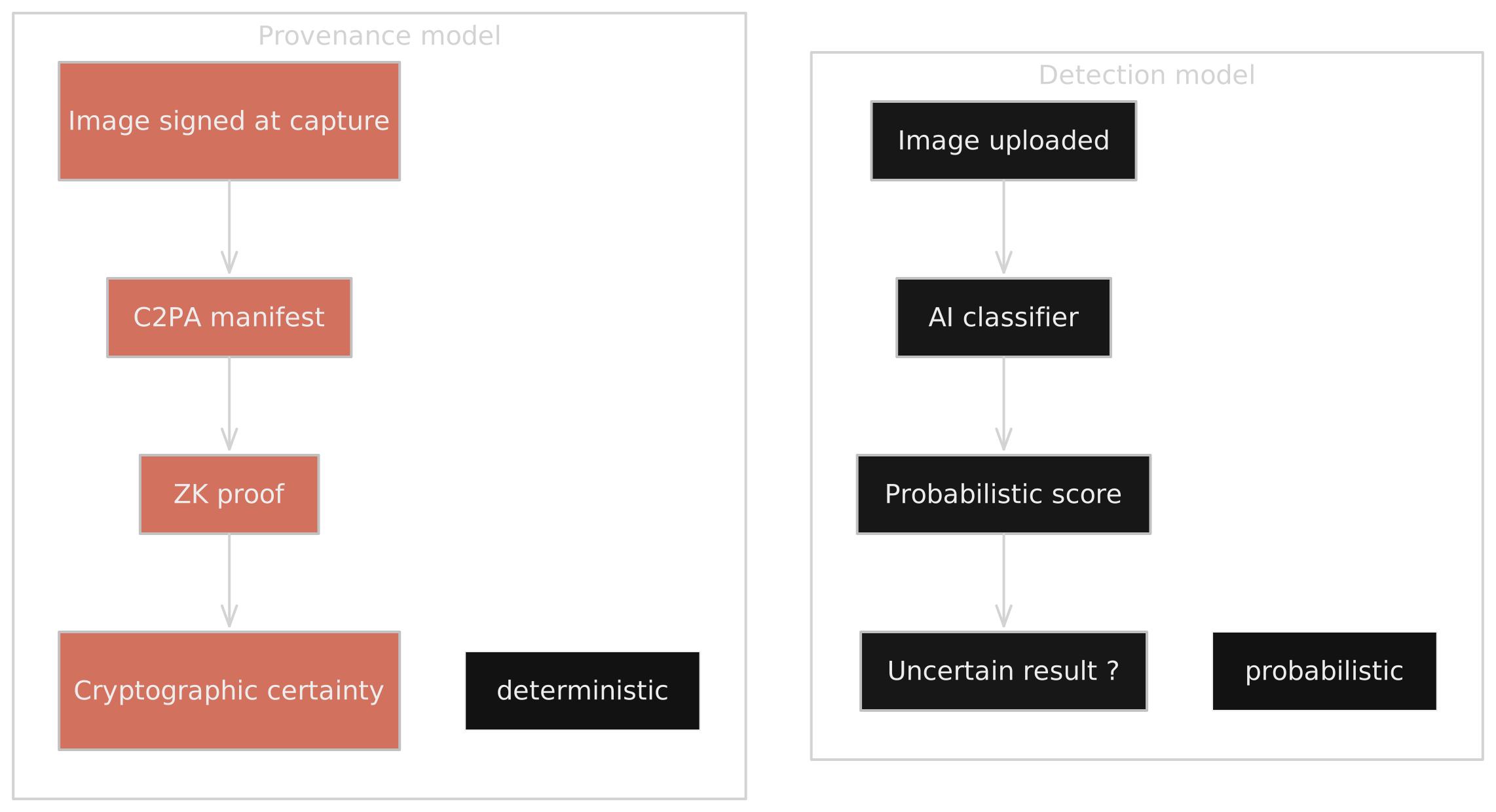
C2PA provides the signature. It's the chain of custody from camera to image. Zero-knowledge proofs provide the privacy. They verify the chain of custody without revealing it. Blockchain provides permanence. The verification result is recorded immutably, privately, and independently of any single company.
That's what Apertrue builds. The next section explains how C2PA manifests are extracted and prepared for proof generation.